
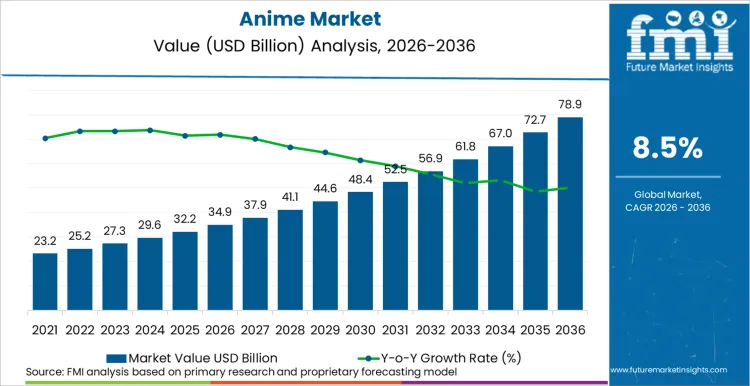
The numbers are staggering. In 2025, the global anime market was valued at $31.39 billion. By 2026, that figure is projected to hit $34.52 billion. By 2031, industry analysts expect it to reach a whopping $49.6 billion. Some forecasts are even more bullish, predicting the market could soar to $129.72 billion by 2037.
This isn’t just niche entertainment anymore. This is anime growth on a global scale—a cultural and economic phenomenon that has redefined how the world consumes animated storytelling. From Netflix record-breakers to theatrical blockbusters, from merchandise empires to international co-productions, anime has officially entered the mainstream.
But what exactly is driving this explosive anime growth? Why is 2026 shaping up to be the most pivotal year yet for the industry? And what does this mean for fans, creators, and businesses alike?
In this article, we’ll break down seven powerful reasons why anime growth is accelerating at an unprecedented pace, supported by hard data, industry trends, and the cultural shifts that are transforming Japanese animation into a global juggernaut.
1. The Market Is Doubling—And Then Some
Let’s start with the numbers because they tell the most compelling story. The anime market isn’t just growing; it’s accelerating.
According to Mordor Intelligence, the anime market was valued at USD 27.1 billion in 2025 and is forecast to reach USD 49.6 billion by 2031, registering a compound annual growth rate (CAGR) of 10.6%. Other research firms paint an even brighter picture. The Business Research Company reports that the market grew from $31.39 billion in 2025 to $34.52 billion in 2026 at a 10% CAGR. By 2033, some projections estimate the market could reach $77.26 billion.
What makes these figures particularly remarkable is the anime growth trajectory. Unlike traditional media sectors that have plateaued, anime is experiencing a surge driven by multiple converging factors: the rise of streaming platforms, expanding into emerging markets, adoption of AI-based animation tools, increasing cross-cultural collaborations, and rising merchandise and licensing revenue.
In short, anime growth isn’t a bubble—it’s a fundamental restructuring of the global entertainment landscape.
2. Streaming Platforms Are Fueling the Fire
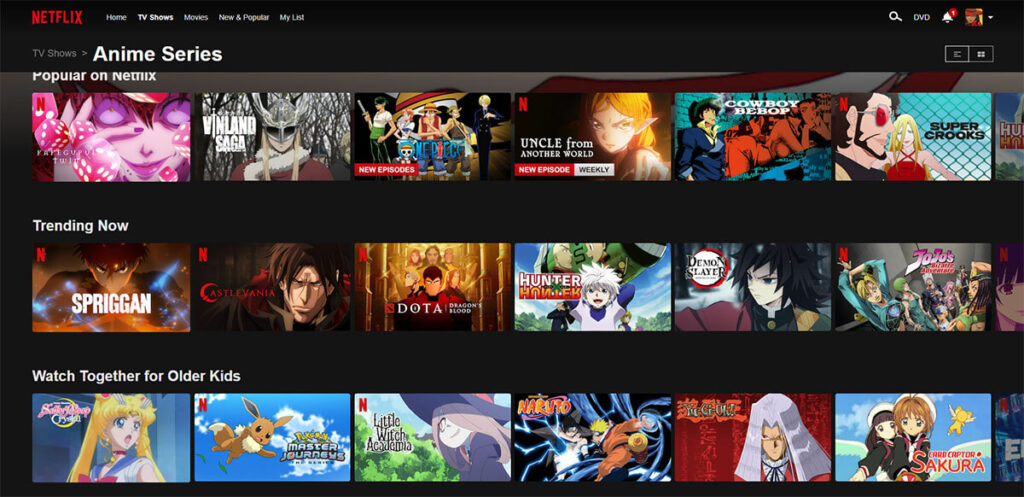
If there’s one single factor that has turbocharged anime growth, it’s streaming. Platforms like Netflix, Crunchyroll, Amazon Prime Video, and Hulu have made anime accessible to audiences who would never have encountered it through traditional broadcast channels.
The numbers speak for themselves. In 2025 alone, Netflix recorded over 8 billion hours of anime watched on its platform—a 10.6% increase from the previous year. During the final six months of 2025, anime represented over 4% of all viewing on Netflix, accounting for 3.84 billion hours of watch time.
But here’s where it gets even more interesting: Netflix captured 38% of 2023 subscription revenue linked to anime viewers, confirming the format’s draw for large-scale platforms. Crunchyroll’s participation in production committees expanded from 21 titles in 2019–2021 to 62 titles in 2022–2023, equal to about one-fifth of late-night series output.
Wall Street has taken notice too. Bernstein recently forecast that the international streaming market for anime could triple by 2030 to hit US$12.5 billion in annual revenue.
The streaming revolution has done more than just distribute anime—it has fundamentally changed how it’s produced. Platforms now take direct equity stakes in productions, giving them subscription income plus backend royalties, improving payback cycles versus pure licensing deals. This financial integration means more investment, more series, and ultimately, more anime growth.
3. 2026 Is Stacked with Must-Watch Series

If you’re looking for proof of anime growth, look no further than the 2026 release slate. This year is absolutely packed with heavy hitters—both returning favorites and brand-new sensations that are already generating massive buzz.
Jujutsu Kaisen Season 3 has reached new heights of quality with its long-anticipated adaptation of the Culling Game arc, described as “by far, the most gorgeous anime in the Winter 2026 lineup”. The series’ high-octane encounters and top-notch animation have cemented its place as one of the most popular anime series today.
Witch Hat Atelier has emerged as arguably the strongest new series of 2026, proving why it generated so much excitement before its debut. Alongside it, new properties like Daemons of the Shadow Realm have taken the anime world by storm.
Returning favorites are also dominating. One Piece continues its legendary Elbaf arc, Dr. Stone is wrapping up its long-running saga, and Link Click Season 3 is coming back soon. Even iconic franchises like b are returning in 2026 with a reimagining handled by studio Science Saru.
The diversity of content—from shonen action to dystopian political drama like Nippon Sangoku—demonstrates how anime growth is driven by an ever-expanding range of genres that appeal to audiences of all ages and tastes.
Don’t forget to check:
Why Yani Neko Is 2026’s Most Shocking Anime Hit
4. The Numbers Behind the Hits: What People Are Actually Watching
To understand anime growth, we need to look at what fans are actually watching—and the data reveals some fascinating insights.
Netflix’s What We Watched report for the second half of 2025 showed that Demon Slayer: Kimetsu no Yaiba claimed the top spot with 54.8 million views. The franchise accounted for more than 8% of all anime watch time on Netflix during this period, likely fueled by theatrical excitement surrounding the Infinity Castle movie’s record-breaking run.
Naruto followed with 45.4 million views, proving that even long-completed series continue to drive massive engagement. Studio Ghibli movies collectively brought in 39.1 million views, led by classics like Spirited Away, Howl’s Moving Castle, and My Neighbor Totoro.
One Piece pulled in 36.7 million views, Pokémon 33.3 million, and newer hits like Dandadan 23.9 million. The top 10 also included Record of Ragnarok, The Seven Deadly Sins, One-Punch Man, and My Hero Academia.
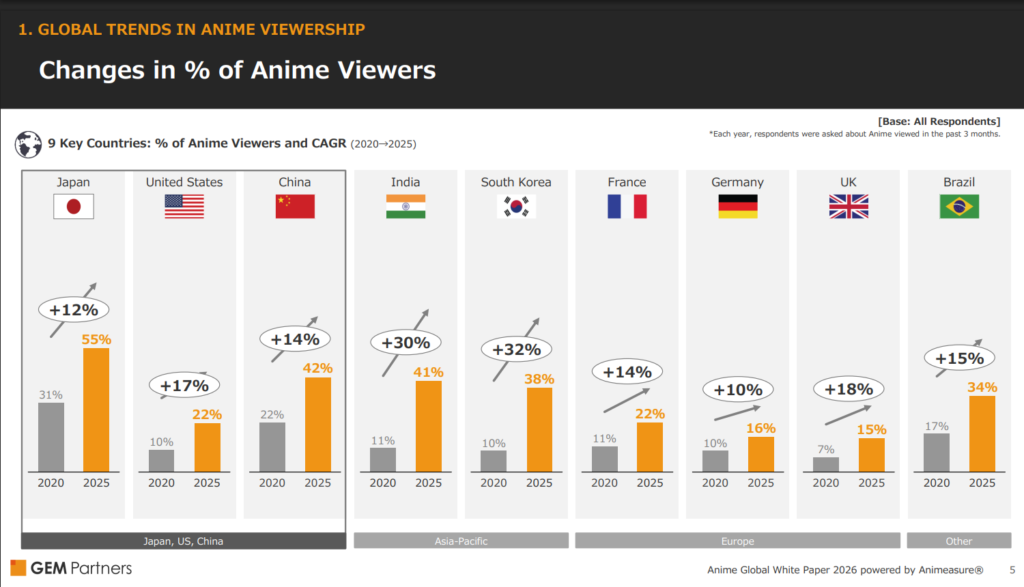
What’s particularly striking is the global nature of these viewing patterns. The Anime Global White Paper 2026 revealed that Japan remained the largest anime-viewing market in 2025 at 55%, followed by China at 42% and India at 41%. The United States saw its anime viewership reach 22% in 2025, up from just 10% in 2020—a compound annual growth rate of 17%.
Anime growth is truly a global phenomenon, with audiences spanning every continent and demographic.
5. India’s Explosive Rise: A New Giant Emerges

Perhaps the most remarkable story in anime growth right now is happening in India. According to the Anime Global White Paper 2026, India has emerged as one of the world’s biggest anime markets, ranking behind only Japan and China.
The numbers are staggering. India’s anime viewership grew from 11% in 2020 to 41% in 2025—an average annual growth rate of 30%. That’s faster than any other major market. Even more impressive: 79% of Indian anime viewers are paying consumers, a higher share than in Japan, where only 55% are viewers and 32% are spenders.
Genre preferences in India stand out from other markets too. Comedy ranked especially high at 49%, making India an outlier compared with countries where action titles usually dominate. Popular genres included Action/Adventure (45%), Sci-fi (41%), Thriller (41%), and Drama (39%).
The most-watched anime titles in India were Pokémon, Dragon Ball, Naruto/Boruto, Attack on Titan, and One Piece. Netflix, Prime Video, and YouTube are the top services where Indian audiences watch anime.
This anime growth in India represents a massive opportunity for the industry. With a population of over 1.4 billion and a young, digitally-savvy demographic, India could become one of the most important markets for anime in the coming decade.
6. Anime Is Going Mainstream—And Gen Z Is Leading the Charge
One of the most significant drivers of anime growth is the mainstreaming of anime culture, particularly among younger generations.
A May 2025 Crunchyroll-NRG report found that anime is especially popular among 13- to 28-year-olds (54%)—outpacing the NFL (48%) and even global pop phenomenon BTS (39%) for attention. The study also shows that the share of viewers watching anime on a weekly basis grows to 50% among Millennials and Gen Z globally.
This isn’t just about watching shows. Anime has become a lifestyle. Fans are active consumers of merchandise, with adult collectors in North America driving USD 1.5 billion in toy spending during Q1 2024. Financial services providers have even issued anime-themed credit cards that deliver higher profit margins than standard offerings.
Theatrical releases are also performing exceptionally well. Films like “Hatsune Miku: Colorful Stage! The Movie” secured USD 2.77 million in its US opening weekend, outperforming the Japanese debut and signaling broad theatrical appeal.
As Western producers increasingly draw on anime’s power, the lines between “anime” and “mainstream entertainment” continue to blur. This cultural crossover is accelerating anime growth by introducing the medium to audiences who might never have considered watching Japanese animation before.
7. The Future: What’s Next for Anime Growth?
Looking ahead, the trajectory for anime growth shows no signs of slowing down. Industry analysts project the market will reach $49.6 billion by 2031, with some estimates going as high as $70.90 billion by 2032.
Several key trends will shape this future anime growth:
Globalization of anime culture continues to expand, with overseas revenues now overtaking domestic earnings and prompting studios to strengthen localization and co-production capabilities.
Technology and AI are transforming production. Chronic labor shortages have spurred experiments with generative artificial intelligence, compressed production cycles, and strategic alliances that link content libraries with direct-to-consumer channels. However, production budgets have climbed two-to-three-fold in the past decade, and half the workforce logs more than 225 hours monthly, well above Japan’s national average of 163.5 hours. Investment in AI offers relief but requires capital that many smaller studios lack.
Merchandising and licensing are becoming increasingly important revenue streams. Major companies like Toei Animation, Sanrio, Netflix, and Bandai Namco Holdings are all expanding their anime-related operations. Good Smile Company continues to innovate with products like Nendoroid figurines, while Toho’s acquisition of Science SARU demonstrates how major entertainment companies are betting big on anime.
Cross-media storytelling is another major trend. Anime is no longer just a standalone medium—it’s part of interconnected ecosystems that include manga, games, merchandise, live events, and financial services. This integration creates multiple revenue streams and deepens fan engagement.
Conclusion: The Anime Growth Story Is Just Beginning
The numbers don’t lie. Anime growth in 2026 represents one of the most exciting stories in global entertainment. With a market valued at over $34 billion, billions of streaming hours, and a fanbase that spans every continent, anime has firmly established itself as a cultural and economic powerhouse.
From the record-breaking success of Demon Slayer to the explosive rise of India as a major market, from the streaming revolution to the mainstreaming of anime culture among Gen Z—every indicator points to continued anime growth for years to come.
For fans, this means more content, more variety, and more ways to engage with the stories and characters they love. For creators, it means new opportunities and new challenges in an increasingly competitive global landscape. For businesses, it means a market that is ripe for investment and innovation.
Whether you’re a lifelong otaku or someone just discovering the magic of Japanese animation, one thing is clear: anime growth is not just a trend. It’s a revolution. And 2026 is the year it all comes together.
So grab your popcorn, queue up your favorite series, and watch as anime takes over the world—one episode at a time.