
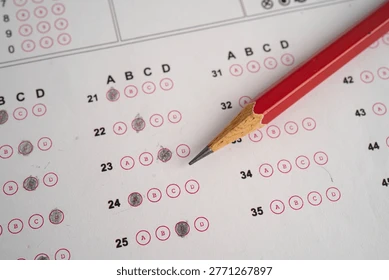
If you grew up in Indonesia, you are undoubtedly familiar with the sheer panic of entering an exam room and realizing you forgot your primary weapon. For decades, Indonesian students facing the National Exams (Ujian Nasional) or university entrance tests have shared a collective, undisputed rule: you must use specific writing tools. Specifically, the education system strictly mandates the use of 2B Pencils.
But why is this specific grade of pencil so incredibly crucial? Why would a standard HB pencil or a regular pen lead to a failed exam score? The answer lies at the fascinating intersection of education policy, optical technology, and material science. In this comprehensive guide, we will dive deep into the mechanics of standardized testing in Indonesia, explore exactly what these pencils contain, and uncover the scientific reasons why 2B Pencils became the ultimate standard for computer-graded exams.
The History of 2B Pencils in Indonesian Education
To understand the dominance of 2B Pencils, we must first look back at how exams in Indonesia evolved. Before the era of rapid computerization, teachers graded exams manually. This process was extremely time-consuming, prone to human error, and virtually impossible to scale on a national level for millions of students.
When the Indonesian government introduced standardized testing formats like Ebtanas (Evaluasi Belajar Tahap Akhir Nasional) and later the Ujian Nasional (UN), they needed a way to grade millions of answer sheets quickly and accurately. This necessity birthed the widespread adoption of the Lembar Jawaban Komputer (LJK) or Computer Answer Sheet.
The LJK relies entirely on OMR (Optical Mark Recognition) technology. OMR scanners are designed to process hundreds of papers per minute by shining a light onto the paper and detecting where the light is blocked by dark marks. To ensure the scanners worked perfectly, the government and testing bodies had to standardize the marking tool. This is where 2B Pencils entered the spotlight. They were officially mandated because they provided the exact consistency required by the early optical scanners used by the Ministry of Education.
What Exactly Are 2B Pencils?
To comprehend why this specific tool is necessary, we must answer a fundamental question: what exactly is inside 2B Pencils? Contrary to popular belief, pencils do not contain lead. The core of a pencil is made of a mixture of graphite and clay.
The European pencil grading system uses letters and numbers to indicate the hardness and blackness of the pencil’s core.
-
H stands for Hard. These pencils have more clay in their mixture, producing a lighter mark that is less likely to smudge.
-
B stands for Black. These pencils have a higher ratio of graphite, producing a softer, darker mark.
Therefore, the “2B” designation means the pencil is on the softer, darker end of the spectrum, precisely two steps into the “Black” category. The core of 2B Pencils contains a scientifically balanced ratio of approximately 74% graphite, 20% clay, and about 6% waxes and other binding agents. This specific formulation is the secret to its success in standardized testing environments.
The Technology: How OMR Scanners Read 2B Pencils
The core reason why Indonesian exams strictly require 2B Pencils is directly tied to how Optical Mark Recognition (OMR) machines function.
When you submit your LJK, it is fed into an OMR machine. This scanner uses specialized sensors that emit light—often infrared—onto the paper. The white areas of the paper reflect the light back to the scanner’s sensors. However, graphite is a crystalline form of carbon. Carbon has a unique property: it absorbs light and reflects very little of it, especially under infrared sensors.
When you fill in a bubble with 2B Pencils, you are depositing a thick layer of crystalline graphite onto the paper. As the OMR scanner’s light hits that specific bubble, the graphite absorbs the light. The sensor registers a drop in light reflection, and the computer’s software translates that “dark spot” as your chosen answer. If the graphite layer is not thick or dark enough, the scanner will register a false reflection and assume the bubble was left blank, resulting in a zero for that question.
Don’t forget check this:
7 Amazing 3D Printing Secrets
Why Other Grades Fail Compared to 2B Pencils
You might wonder why a 4B pencil, which is even darker, or a standard HB pencil, which is more common globally, cannot be used. The strict requirement for 2B Pencils is a matter of Goldilocks perfection: it is neither too hard nor too soft.
If you use an HB or H pencil, the graphite mixture contains too much clay. The mark it leaves is quite light and reflective. When the LJK goes through the OMR scanner, the light mark from an HB pencil might reflect too much infrared light back to the sensor. The scanner will fail to “see” the answer, leading to devastating unrecorded scores for the student.
On the other hand, if you use a 3B, 4B, or 6B pencil, the graphite is incredibly soft. While these will definitely block the scanner’s light, they come with a massive drawback: smudging. Because the core is so soft, the graphite dust easily spreads across the paper. If a student accidentally brushes their hand across a bubble filled with a 4B pencil, the graphite dust can migrate into adjacent bubbles. The highly sensitive OMR scanner might read these smudges as multiple answers, automatically invalidating the question. 2B Pencils strike the absolute perfect balance—dark enough to be read perfectly by the scanner, but hard enough to resist severe smudging.
The Crucial Erasability of 2B Pencils
Another monumental factor in the selection of this specific pencil grade is erasability. In a high-stakes exam environment, students frequently change their minds. They need to be able to erase a shaded bubble completely and fill in a new one without destroying the answer sheet.
Because 2B Pencils contain just the right amount of clay, the graphite binds to the surface of the paper fibers without scoring or digging deeply into the paper itself. When a student uses a high-quality eraser, the rubber easily picks up the graphite particles from the surface.
If a student were to use a harder H pencil, they would have to press down harder to make a visible mark. This physical pressure creates microscopic grooves in the LJK paper. Even if the graphite is erased, the physical dent in the paper can cast a shadow under the scanner’s light, potentially confusing the OMR machine. The soft glide of 2B Pencils prevents paper damage while allowing for clean, complete corrections.
The Psychology and Ritual of 2B Pencils
Beyond the technical and scientific reasons, the use of 2B Pencils in Indonesia has taken on a deeply psychological and cultural significance. For students, preparing their stationery the night before a major exam is a grounding ritual.
Sharpening a set of high-quality 2B Pencils—often heavily marketed by brands like Faber-Castell, Joyko, or Staedtler specifically for computer exams—provides a sense of control in a stressful situation. The physical act of holding a familiar, trusted tool can reduce exam anxiety. In Indonesia, the phrase “Pensil 2B Khusus Ujian” (2B Pencil specifically for exams) is heavily branded on packaging, complete with OMR-tested guarantees. This marketing reassures students and parents alike that they are equipped with the safest, most reliable tool to secure their academic future.
Enjoy this article so far? Don’t forget to check this too!
7 Amazing Eras of Indonesian VTubers
The Future of 2B Pencils in Digital Exams
Today, the landscape of education in Indonesia is rapidly shifting towards Computer-Based Testing (Ujian Nasional Berbasis Komputer or UNBK, and UTBK for university entrance). Students now frequently click a mouse rather than shade a bubble.
Does this mean the era of 2B Pencils is coming to an end? Not entirely. While the national reliance on OMR sheets has decreased, many regional schools, local try-outs, daily quizzes, and specific institutional tests still rely heavily on paper LJKs due to the lack of computer infrastructure in remote areas. Furthermore, the tactile reliability of physical answer sheets ensures that OMR technology will remain a vital backup system for years to come.
The legacy of 2B Pencils is permanently etched into the history of Indonesian education. They represent an era where a simple mixture of wood, graphite, and clay bridged the gap between human knowledge and computer technology. By perfectly balancing darkness for visibility and hardness for cleanliness, these unassuming wooden tools ensured that millions of students were accurately graded and fairly evaluated.