
The Siak explosion is a tragedy that has deeply shaken Indonesia’s education system. This fatal Siak explosion claimed the life of a junior high school student during what was supposed to be a routine science practical exam. Now, the incident has led to criminal prosecution, sparking urgent questions about school safety nationwide.
SIAK, RIAU – Police in Riau have officially named a 35-year-old teacher, identified only by the initials IP, as a suspect in connection with the deadly Siak explosion. The blast occurred at the Islamic Center Junior High School in Siak, killing a ninth-grade student and sending shockwaves through the entire community. The Siak explosion is now a focal point in discussions about negligence, student supervision, and the limits of school science projects.
The devastating event took place on Wednesday, April 8, during a “Science Show” where students presented their practical exam projects. What began as a showcase of youthful innovation ended in catastrophe. Below are five horrifying facts uncovered during the investigation into this Siak explosion case.
The Victim Built a Functional 3D-Printed Rifle for a School Project
The victim, a 15-year-old student identified as MAA, was presenting a project far removed from traditional school experiments. He had constructed a homemade rifle using 3D printing technology, a device designed to fire actual projectiles. This dangerous creation ultimately led to the Siak explosion that cost him his life.
Classmates who witnessed the presentation said MAA understood the inherent risks of his creation. Before the test firing, he explicitly warned his friends to keep a safe distance. He took his position on the school field, aimed the device, and pulled the trigger. But instead of firing a pellet, the entire contraption exploded with devastating force—resulting in the tragic Siak explosion that no one present will ever forget.
The Supervising Teacher Knew the Project Used Explosive Materials
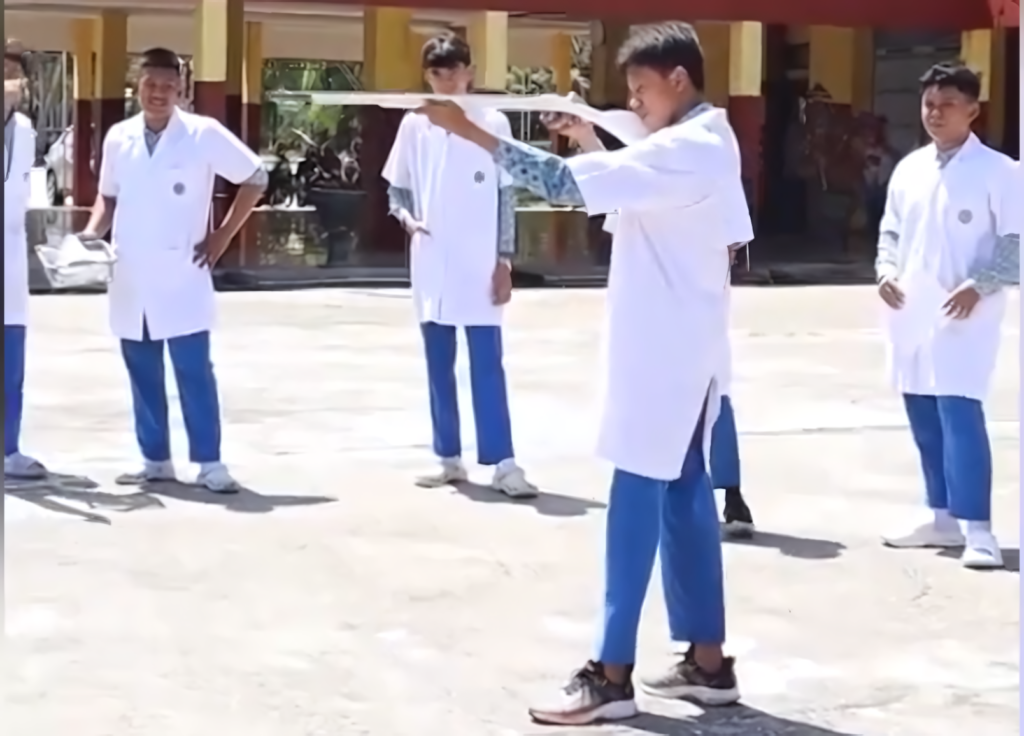
This is perhaps the most troubling revelation from the police investigation into the Siak explosion. According to Siak Police Chief AKBP Sepuh Ade Irsyam Siregar, the teacher, IP, had full knowledge of what the student was building.
“The suspect knew that the student’s creation could cause an explosion. The victim had already explained the materials used and how the device worked. Despite this, the teacher still gave permission to test it on the school field,” Siregar stated during a press conference regarding the Siak explosion case.
This prior knowledge is the foundation of the criminal negligence charges now facing the teacher. School safety protocols clearly prohibit experiments involving actual explosives, and yet, this project was allowed to proceed under adult supervision. The Siak explosion raises a haunting question: why was this ever given a green light?
Deadly Fragments Struck the Student in the Face and Head
The Siak explosion did more than destroy the 3D-printed device. It sent razor-sharp fragments flying in all directions. Pieces of metal, plastic, and other debris tore across the school field, with some hitting the walls of nearby buildings and the school’s assembly hall.
Tragically, the most lethal fragments from the Siak explosion struck MAA directly in the face and head. The injuries were catastrophic and immediate. Friends and teachers who rushed to his aid quickly transported him to the Siak Regional General Hospital. Despite the medical team’s best efforts, the young student could not be saved. He succumbed to wounds sustained in the Siak explosion shortly after arrival.
Police Confiscated a Disturbing Cache of Evidence
Investigators have worked tirelessly to piece together the full picture behind the Siak explosion. In total, 16 witnesses have been formally interviewed, including fellow students who watched the event unfold, other teachers present at the science show, and independent forensic experts.
The list of items confiscated after the Siak explosion reveals just how sophisticated and dangerous the student’s project truly was. Police seized the following evidence from the scene and related locations:
-
A 3D printer used to manufacture the rifle components.
-
A laptop containing design files and project documentation.
-
A camera that may have recorded the test.
-
3D-printed gun parts, including the stock and barrel.
-
Two black iron pieces measuring 70.5 cm and 81 cm, plus 60 round iron pellets intended as ammunition.
-
Black powder (gunpowder), fuses, matches, and pieces of mosquito coils believed to be used as the trigger mechanism.
This evidence paints a clear picture of a deliberate, premeditated construction project that should never have been allowed. The Siak explosion stands as undeniable proof of what happens when safety checks fail.
The Negligence Charges Could Mean Years Behind Bars

The legal system has moved swiftly in response to the Siak explosion. Teacher IP now faces formal charges under Article 474 Paragraph (3) of the Indonesian Criminal Code (KUHP). This specific article addresses criminal negligence that results in the loss of human life.
If the court finds the suspect guilty for his role in the Siak explosion tragedy, the punishment is severe. IP faces a maximum prison sentence of five years. Alternatively, the court may impose a Category V fine, a substantial financial penalty under Indonesian law.
This case has sparked intense public debate about student safety, teacher responsibility, and the boundaries of school science projects. For more updates on legal cases in Indonesia, you can visit the official website of the Indonesian National Police.
Why the Siak Explosion Is a Nationwide Wake-Up Call
The Siak explosion is not just a local news story. It is a cautionary tale that resonates with educators, parents, and policymakers across the country. Schools are supposed to be safe spaces where curiosity and creativity are nurtured, not places where lives are put at risk due to negligence.
In the aftermath of the Siak explosion, experts in educational safety have weighed in. They emphasize that all student projects involving chemistry, physics, or engineering must undergo rigorous risk assessments. A simple safety checklist and formal approval from a qualified supervisor could have prevented the Siak explosion entirely.
Parents at the Islamic Center Junior High School are demanding answers and systemic reforms. The local education department has promised a full review of safety protocols at all schools under its jurisdiction. However, for the family of MAA, these measures come far too late. The Siak explosion has already taken an irreplaceable life.
This tragedy also raises questions about student access to advanced technology like 3D printers. Once rare and expensive, they are now increasingly available. While they unlock incredible learning opportunities, they also introduce new risks. The Siak explosion serves as a grim reminder that innovation without supervision can have deadly consequences.
Enjoy this article? Don’t forget to check this one too: Wanted Person Frendry Dona The Mastermind of Hidden Etomidate Vape Lab in East Jakarta