
Understanding the Rupiah Exchange Rate Crisis
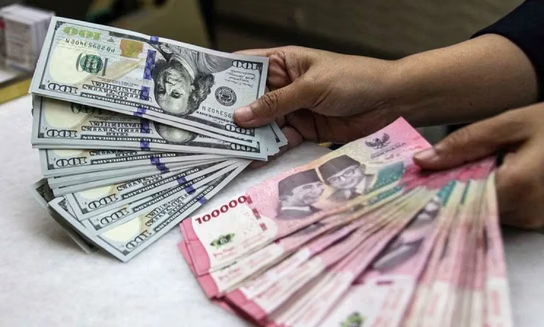
In mid-May 2026, the Indonesian rupiah touched Rp17,600 per US dollar. That is a new record low. Many people are asking whether they should be worried.
To answer that, we must first understand what an exchange rate actually is. It is simply the price of one currency in terms of another. When that price rises (more rupiah per dollar), we say the rupiah has weakened.
A weaker currency sounds alarming. But its real-world effect depends entirely on what you buy and sell. This guide will walk you through the causes, the historical parallels, the short-term pain, the long-term risks, and finally a neutral bottom line.
Three Reasons Behind the Fall
Three main forces are pushing the rupiah down today. Each one alone might not cause a crisis, but together they create serious pressure.
Reason 1: The US Dollar Is Extremely Strong
The US Federal Reserve has kept interest rates high for years. Global investors sell other currencies to buy dollars because dollar assets offer better returns. This global trend affects every currency, including the rupiah. The exchange rate naturally tilts in favor of the dollar under these conditions.
Reason 2: Geopolitical Fear Drives Money to Safety
Ongoing conflicts in the Middle East and tensions elsewhere make investors nervous. When the world feels unsafe, people rush to the US dollar as a “safe haven.” This increased demand for dollars pushes the rupiah lower.
Reason 3: Domestic Concerns About Indonesia’s Budget
Indonesia’s budget deficit is near 3% of GDP. Some foreign investors worry about government spending. They pull money out of Indonesian assets. To leave, they must sell rupiah and buy dollars. That transaction directly weakens the exchange rate.
All three reasons converge on one outcome: a weaker currency.
Past Crises: 1998, 2008, and Today
Indonesia has survived terrible currency collapses before. But today is different.
The 1998 Asian Financial Crisis
In 1998, the rupiah collapsed from Rp2,400 to Rp16,800 in months. Banks failed. Companies could not pay foreign debts. The government fell. It was an economic earthquake. The exchange rate reflected a total systemic breakdown.
The 2008 Global Financial Crisis
In 2008, the rupiah fell to around Rp12,000–13,000. But Indonesia’s banking system was stronger. The country recovered within a year. The exchange rate stabilized as global conditions improved.
Today’s Situation (2026)
Today the rupiah is at Rp17,600 – numerically weaker than in 1998. However, Indonesia is not facing a banking collapse or hyperinflation. The current weakness is driven more by global dollar strength and investor caution, not a domestic meltdown. It is serious but not yet a systemic crisis.
Don’t forget check this article too: Siak Explosion: 5 Horrifying Facts About the School Science Tragedy
How a Falling Exchange Rate Affects You Short‑Term
A weaker currency creates rapid, visible effects. Here is what can change in weeks or months.
Imported Goods Get More Expensive

Indonesia imports wheat, soybeans, electronics, and machinery. When the rupiah falls, those imports cost more in local money. Sellers raise prices. For example, tofu makers recently saw soybean prices jump from Rp7,000 to Rp10,500 per kg because of the weaker exchange rate.
Travel and Overseas Education Cost More

If you plan to study abroad or take a foreign vacation, every dollar you need now costs more rupiah. A hotel that was $100 per night might have cost Rp1,500,000 last year. Today it could cost Rp1,760,000.
Some Businesses Struggle

Manufacturers that rely on imported raw materials see their costs rise. They may raise prices, cut staff, or both. But note: these effects only happen when a transaction involves foreign currency.
Long-Term Risks for the Economy
Over years, a consistently weak currency can reshape the economy in troubling ways.
Gradual Loss of Purchasing Power
If the rupiah keeps falling, everything connected to global trade becomes more expensive over time. This slowly reduces what ordinary people can buy with their salaries. A sustained weak exchange rate erodes living standards gradually.
Foreign Investment May Shrink
Investors dislike unpredictable currency movements. A volatile exchange rate makes Indonesia look riskier than stable neighbors like Singapore or Vietnam. Investment that could create jobs might go elsewhere.
Heavier Debt Burden
Many Indonesian companies and even the government have borrowed in US dollars. When the rupiah weakens, those debts become much larger in rupiah terms. This drains corporate profits and the national budget.
Higher Interest Rates Could Follow
To defend the currency, Bank Indonesia might raise interest rates. That makes car loans, house loans, and business loans more expensive for everyone, slowing the entire economy.
The Neutral Truth About the Exchange Rate
After all this analysis, here is the clearest statement I can offer. The rupiah-dollar exchange rate only directly affects transactions that are priced in foreign currency.
If you buy a locally grown vegetable from a farmer who uses local seeds, local labor, and local transport – that price is almost entirely in rupiah. The dollar-rupiah rate has no direct role.
But if you buy an imported smartphone, order raw materials from abroad, pay for a server hosted in the US, or book a flight on a foreign airline – then the exchange rate directly determines how much you pay in rupiah.
In other words: the currency rate matters only when you step into global trade. For purely local, closed-loop economic activity, its power is minimal. This is why some people panic while others shrug. Neither is wrong. They simply live in different parts of the economy – one connected to the world, one rooted in the local.
Final Takeaways
The rupiah at Rp17,600 is a serious signal. It tells us that global dollar strength, geopolitical fear, and local fiscal worries are combining to put pressure on Indonesia’s currency.
-
Short-term: Importers, travelers, and students abroad will feel pain quickly.
-
Long-term: If the weak exchange rate persists, investment may slow and debt burdens may rise.
-
Neutral fact: If you live and shop entirely within local, non-imported supply chains, the direct impact is limited.
Understand where you stand in the economy. Then decide how much to worry.